
What Is the eDiscovery Job Market Like in Pittsburgh?
Pittsburgh's eDiscovery market is booming — discover the roles, skills, and salary trends defining this competitive legal tech landscape.

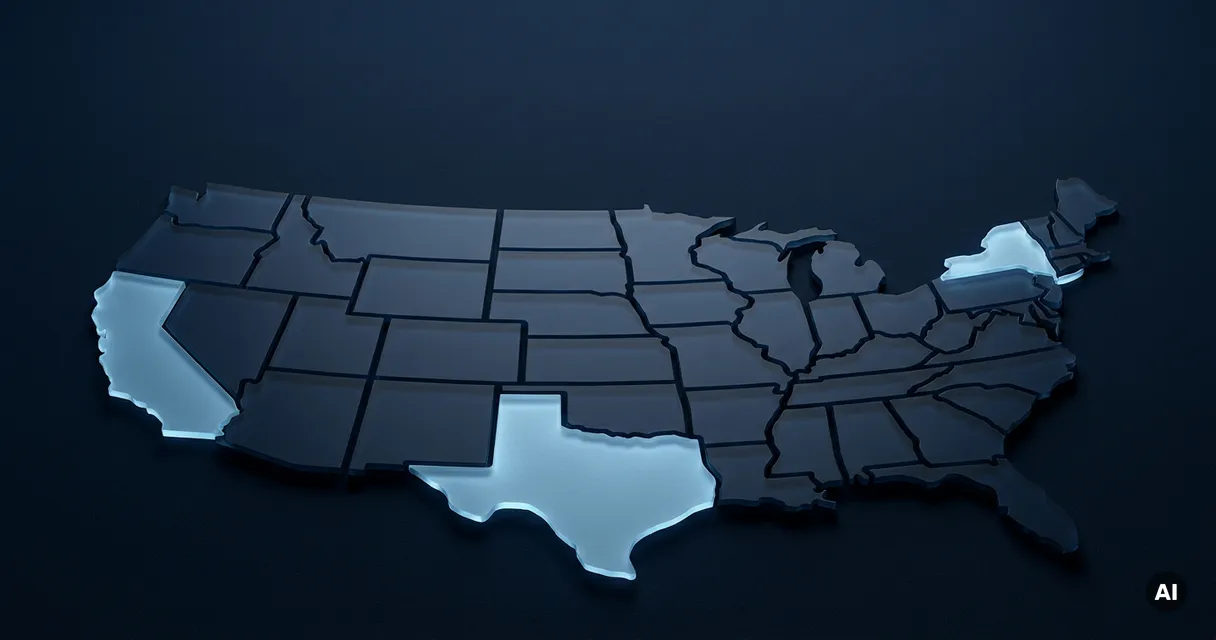
The states with the strictest data privacy laws for businesses in 2026 are California, Virginia, Colorado, Connecticut, and Texas. California leads the field with its layered legislative framework, but several other states have enacted robust consumer privacy protections that impose significant compliance obligations on businesses operating across the US.
Unlike a single federal privacy standard, the US regulatory landscape remains a patchwork of state-level laws, each with its own thresholds, consumer rights, and enforcement mechanisms. Understanding which states impose the heaviest requirements is essential for any business handling personal data in 2026.
Below, we answer the most pressing questions businesses are asking about state data privacy regulations this year.
California, Virginia, Colorado, Connecticut, and Texas have enacted the most comprehensive and strictly enforced state data privacy laws in the US as of 2026. California remains the benchmark, but states like Colorado and Connecticut have introduced provisions that in some respects exceed California’s requirements in terms of opt-out rights and data minimization obligations.
Here is a snapshot of the key states and their primary legislation:
Several other states, including Oregon, Montana, and Delaware, have also enacted comprehensive privacy laws that took effect in 2024 and 2025, expanding the compliance landscape further heading into 2026. Businesses operating nationally should treat each of these frameworks as a distinct compliance obligation rather than assuming that satisfying one state’s law automatically satisfies another’s.
Under the strictest state data privacy laws, consumers generally have the right to access, correct, delete, and opt out of the sale or sharing of their personal data. Most comprehensive state privacy laws also grant the right to data portability and the right to opt out of profiling used for significant decisions such as employment, credit, or housing.
While the specific rights vary by state, the following are common across the strictest frameworks:
California goes further than most states by granting consumers the right to limit the use of sensitive personal information, including precise geolocation, financial data, health information, and the contents of private communications. Colorado and Connecticut similarly impose heightened protections around sensitive data categories, requiring businesses to conduct and document data protection assessments before processing such information.
California’s privacy laws are the most comprehensive and most actively enforced in the US, setting the standard that most other states have modeled their legislation on. The CPRA’s creation of a dedicated enforcement agency, the California Privacy Protection Agency, sets California apart from every other state, where enforcement typically falls to the Attorney General’s office.
California’s framework is broader in several respects. The CPRA introduced the concept of “sensitive personal information” as a distinct category requiring additional protections, a feature that other states have adopted in modified forms. California also has a lower revenue threshold for triggering compliance: businesses that earn more than $25 million in annual gross revenue, handle data of 100,000 or more consumers or households, or derive at least 50% of revenue from selling personal data must comply.
The CPPA’s ability to audit businesses proactively, without waiting for consumer complaints, gives California’s enforcement regime a level of reach that other states’ Attorney General offices do not currently match.
Colorado and Connecticut impose mandatory data protection assessments for a wider range of processing activities than California currently requires. Virginia’s VCDPA applies to businesses that process data of at least 100,000 residents regardless of revenue, which can capture smaller businesses that fall below California’s revenue threshold but operate at scale in Virginia.
Texas’s TDPSA is notable for its broad applicability and the inclusion of a private right of action in limited scenarios, giving individual consumers a path to sue businesses directly, a mechanism California restricts to data breaches rather than general privacy violations.
Businesses most affected by strict state data privacy laws are those that collect, process, or sell large volumes of personal data, including technology companies, e-commerce platforms, financial services firms, healthcare organizations, and data brokers. Any business operating at scale across multiple states faces layered compliance obligations that compound in complexity.
In the cybersecurity and eDiscovery sectors specifically, the impact is particularly pronounced. Companies in these fields routinely handle sensitive data on behalf of clients, which means they often qualify as both controllers and processors under various state frameworks, triggering obligations on both sides of the data relationship.
The categories of businesses most exposed include:
Small and mid-sized businesses should not assume these laws apply only to large corporations. Several state frameworks, including those in Texas and Virginia, apply based on data volume thresholds rather than revenue alone, meaning a growing business can cross the compliance threshold before it realizes it has done so.
Businesses that violate strict state data privacy laws can face civil penalties ranging from $2,500 per unintentional violation to $7,500 per intentional violation under California’s framework, with no statutory cap on total penalties. Other states impose comparable fines, and repeated or systemic violations can result in penalties that reach into the millions of dollars.
The penalty structures across key states are as follows:
Beyond direct financial penalties, businesses face reputational damage, regulatory scrutiny that can trigger broader audits, and in states with private rights of action, class action litigation. California’s data breach provisions, for example, allow individual consumers to sue for statutory damages without proving actual harm, which has driven significant litigation activity.
Businesses should prepare for multi-state privacy compliance by conducting a thorough data mapping exercise, establishing a unified privacy program that meets the highest applicable standard across all states they operate in, and building internal processes for responding to consumer rights requests within statutory deadlines.
A practical multi-state compliance approach involves the following steps:
For businesses in the cybersecurity and eDiscovery sectors, building a privacy-competent workforce is as important as implementing the right technology. Hiring professionals who understand the intersection of data privacy law and technical operations is increasingly a competitive differentiator, not just a compliance necessity.
Navigating the complexity of state data privacy regulations requires more than legal counsel and updated policies. It requires people: privacy engineers, data protection officers, legal technologists, and eDiscovery specialists who understand how these laws translate into operational practice.
At Iceberg, we connect organizations with the specialized talent they need to build and sustain privacy-compliant operations across jurisdictions. Here is how we support businesses facing multi-state compliance challenges:
If your organization is scaling its privacy and eDiscovery capabilities in response to tightening state regulations, get in touch with us to discuss how we can help you find the right people, faster.